Our Story
The Thalidomide Society
As time moves on the Thalidomide Community find that many younger people have little understanding of what Thalidomide is and the affect it had on people whose mothers were prescribed the drug.
Below are number of questions and answers that
you may find useful.
What is thalidomide?
Thalidomide is a sedative drug that was originally developed in Germany in 1954 by the pharmaceutical company Chemie Grünenthal. It was marketed in the United Kingdom by Distillers (Biochemicals) Ltd under the brand name Distaval from April 1958 until late 1961. Elsewhere it has been known as Asmaval, Distaval Forte, Tensival, Valgis, Valgraine.
On the Wellcome Library’s SoundCloud page, you can listen to extracts from the oral history interviews which cover themes such as mothers’ guilt, birth stories, prejudice and the memories of one of the best-known prosthetic limb-fitting doctors, Dr Ian Fletcher.
Who took thalidomide?
Thalidomide was promoted as a ‘wonder drug’ to treat a range of conditions including headaches, insomnia, and depression. It was popular because it was atoxic, meaning it was impossible to overdose on it. It was remarketed as a short-term treatment for pregnant women, typically in the first three months of their pregnancy, to combat morning sickness or insomnia, although it was also prescribed for bronchitis and influenza amongst other things. It also appeared in cough medicines for children, and so often it stayed in medicine cabinets long after its withdrawal from the market.
When was the first thalidomide-affected baby born?
In West Germany in 1956 to a Grünenthal employee.
What damage to babies does thalidomide cause?
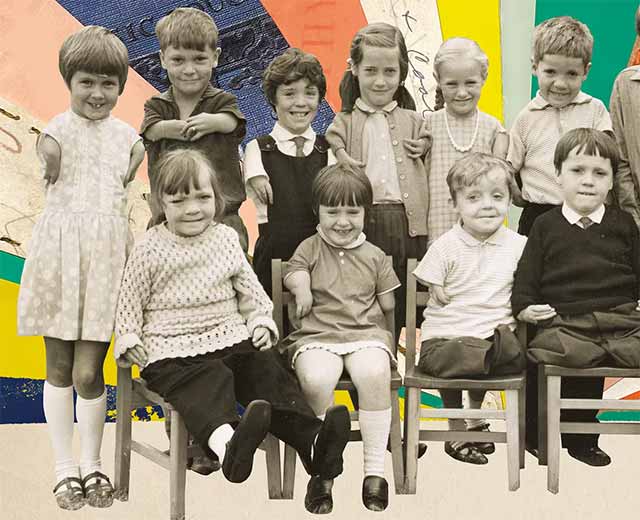
The main impairments caused by thalidomide affect the limbs and are usually bilateral – either both arms or both legs or all four limbs. The most severe impairment is known as phocomelia, a condition where the long bones of some or all limbs are misshapen and where the hands and feet, which can be either mostly fully formed, malformed, or rudimentary, arise almost on the trunk.
Other impairments cover a wide spectrum of limb disabilities ranging from a substantial shortening of the limbs or entirely missing limbs to less physically disabling conditions such as fused fingers. Thalidomide also affected the eyes and ears, the cardiovascular system, the gastrointestinal tract, and kidneys.
The drug harmed the developing fetus only if taken in the first three months of pregnancy. Studies have shown that the exact timing of the thalidomide intake affected the severity and type of malformations. The UK Ministry of Health Report 112 states that the children could, “suffer reduction deficiencies of the limbs, malformations of the eyes, ears and deafness, defects of the heart and kidneys, and malformations of the alimentary system.”
Which other conditions resemble thalidomide-induced impairments?
Babies have been born with impairments like those caused by thalidomide throughout history. For example, genetic conditions such as TAR syndrome and Holt-Oram syndrome affect both the upper limbs in a way similar to thalidomide. Poland’s syndrome affects the hands, and Talipes Equinovarus affects the foot and ankles. Congenital dysmelia can also affect all the limbs and can present as very similar to thalidomide impairments.
Does the Thalidomide Society support people with similar impairments?
The Thalidomide Society supports everyone with similar conditions who are encouraged to become members and attend our events.
When was Thalidomide withdrawn?
Evidence shows that Chemie Grünenthal ignored warnings about the connection between thalidomide and babies being born with limb and other impairments. In 1961, the Australian doctor William McBride published a letter in The Lancet making this connection public knowledge. Following this and reports of what amounted to an epidemic of births of malformed babies and side effects of peripheral neuritis in adults in Germany, Chemie Grünenthal reluctantly withdrew the drug in November 1961, and Distillers followed suit in December of that year.
However, a UK Government warning was not issued until May 1962. The drug was present in a number of other medications whose labeling did not use the word ‘Thalidomide’. Consequently, at least 20 children were born during and after September 1962 showing typical thalidomide impairments more than nine months after Distaval was withdrawn.
The late Professor Smithells, of the Department of Child Health and Paediatrics at Leeds University, said, “There was a dramatic disappearance of this type of deformity within a year of the drug’s withdrawal.”
When and why was the Thalidomide Society established?
 Following the births of thalidomide-affected babies, as there was no medical or social help in place, families formed their own support group. Please go to About Us to find more information on the history of the Thalidomide Society and what we do today.
How many babies were affected by thalidomide?
There is no absolute figure for how many babies were affected by thalidomide as many were miscarried, stillborn, or died soon after birth. However, it has been estimated that over 24,000 babies were born worldwide, of which 2,000 were born in the UK. In addition, based on medical evidence, experts conservatively estimate that those babies stillborn and miscarried due to thalidomide would add a further 123,000 worldwide, of which 10,000 would have been in the UK. These figures do not include those babies born alive who became victims of state infanticide and so were never registered.
Why were some countries more affected by thalidomide than others?
In the United States, the thalidomide experience was very different from that in Europe. Dr. Frances Kelsey of the US Food and Drug Administration would not accept that the drug had been adequately tested for manufacture and distribution, and as a result, only about 20 thalidomide-impaired babies were born in America due to the limited clinical trials that were carried out.
In contrast, in Germany, the drug was contained in a preparation called Contergan, which was sold over the counter in pharmacies. The use of Contergan resulted in the births of at least 6,000 impaired children, under 2,000 survived. These figures are, of course, based on known deaths and survivors and are likely to be much higher.
How many people affected by thalidomide are still alive in the UK today?
There are currently at least 450 people still alive today in the UK who have thalidomide impairments.
Do thalidomide-affected people have children with similar disabilities?
Thalidomide did not affect the genes of the people who were born damaged by the drug, and so no similar impairments have been passed on to their children.
Was compensation awarded to UK people born with thalidomide impairments?
In February 1968, Distillers paid damages to 62 thalidomide-impaired children born in the UK. This was widely recognized as an inadequate sum of money, and following a high-profile campaign championed by the then proprietor of The Sunday Times, Harold Evans, and his Insight Team in 1972, a final settlement of £20 million was agreed upon in 1973. The Thalidomide Trust was established to provide support and assistance, including annual grants, to all thalidomide survivors. If you think you might be eligible to receive compensation for thalidomide damage, please contact the Thalidomide Trust, www.thalidomidetrust.org.
What is life like for people living with thalidomide impairments?
Most people born affected by thalidomide have gone on to have happy lives with families and a career. However, the wear and tear on their bodies as they get older has become increasingly notable. The Thalidomide Trust has researched issues of health and wellbeing with all of their beneficiaries and the results show that two-thirds rate their physical health as the same or worse than the lowest 2% of the general population
The key health problems noted are:
- Pain which can be severe and/or continuous (90% of beneficiaries noted this).
- Reduced flexibility and mobility, making it difficult to undertake everyday tasks.
- Tingling and numbness.
- Poor mental and emotional health, including anxiety and depression.
The cost of specially tailored clothes, prosthetic limbs, wheelchairs, and hearing implants has been noted as difficult to cover financially, particularly as over 40% find they are no longer able to work due to their disability.